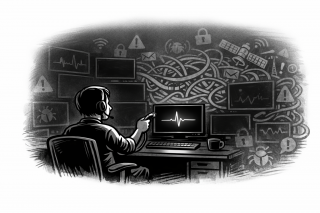
The Myth of “Proactive”
Every company claims to be proactive. They buy dashboards, automate alerts, and call it visibility. But visibility without interpretation is just noise. And noise is the enemy of monitoring.
These days, the market is full of tools that promise prediction. None deliver it. They only record symptoms faster.
What You Actually Need to Monitor
Forget the marketing. You don’t need to monitor everything. You need to monitor what changes your risk posture.
That means:
- Privileged access creation
- Configuration drift
- Unexpected outbound traffic
- Authentication anomalies
- Silent policy overrides
Everything else is vanity metrics.
“Watching the thermometer doesn’t cure the fever.” Monitoring is not observation, it’s correlation.
Tools Are Not the Problem
The tools are fine. The operators are not.
Companies deploy scanners, SIEMs, and vulnerability platforms, then stop thinking. They assume automation equals awareness. It doesn’t.
A tool can find a vulnerability. Only a human can decide if it matters.
The Real Proactive Model
Proactive monitoring is not about alerts. It’s about anticipation.
You build anticipation by:
- Mapping your environment like a living organism.
- Knowing which organs fail first.
- Watching those organs continuously.
- Acting before the failure propagates.
That’s proactive. Everything else is reaction with better branding.
Measure the Silence
The most valuable signal is absence. When logs go quiet, when sensors stop reporting, when metrics freeze, that’s when you’re blind. Blindness is vulnerability.
So you monitor silence. You monitor the watchers. You monitor the integrity of your monitoring.
The Discipline of Knowing Less
The goal is not more data. It’s less uncertainty.
You don’t need infinite telemetry. You need decisive telemetry.
When you know what matters, you stop chasing ghosts. And ghosts are what drain every security budget.