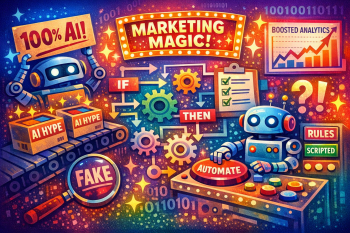
The market is in a phase where “AI” has become a marketing label rather than a technical description. Vendors stretch, exaggerate, or outright misrepresent what their products actually do, and the industry is quietly normalizing it.
I’ve personally seen platforms confidently branded as “AI‑driven” when, under the hood, they are nothing more than deterministic playbooks, static rules, or conditional automation. There is nothing wrong with automation, it is valuable, but it is not AI. Presenting it as such creates confusion, misaligned expectations, and a distorted understanding of what agentic systems actually are.
This is not a small problem. It is a foundational one.
Interface! (Again)
Just like vulnerability management tools hide their limitations behind colorful dashboards, many “AI security platforms” hide their lack of intelligence behind animated graphs and a few buzzwords sprinkled across the UI.
If you cannot see:
- how decisions are made,
- what data is being correlated,
- and whether the system is actually reasoning or simply reacting,
then you are not dealing with AI. You are dealing with a workflow engine with a marketing budget.
The interface of an AI system must expose the logic, not conceal it. If you cannot trace the chain of reasoning, you are not using AI, you are consuming a pre‑packaged illusion of intelligence.
Scoring, Ranking, and the Illusion of “AI Decisions”
Many vendors now claim their “AI” ranks alerts, prioritizes incidents, or scores risks. But when you look closely, the ranking logic is often nothing more than:
- weighted rules,
- static thresholds,
- or a glorified IF/THEN tree.
This is not intelligence. This is a spreadsheet pretending to be a brain.
Real AI systems adapt. They learn. They change their weighting based on context, not based on a vendor’s hard‑coded assumptions. A system that cannot update its own logic is not an AI system, it is a rigid scoring engine with a fancy name.
A rule‑based engine marketed as “AI” is no different than calling a bicycle a “self‑driving vehicle” because it has two wheels and moves forward.
Mitigation: Where AI‑Washing Becomes Dangerous
The biggest damage of AI‑washing is not the marketing. It is the operational impact.
When organizations believe they have “AI‑powered detection” or “AI‑driven response,” they often:
- reduce human oversight,
- skip validation steps,
- or assume the system is catching things it never had the capability to detect.
Most so‑called “AI response engines” cannot:
- reason about multi‑step attacks,
- adapt to new adversarial patterns,
- or evaluate the consequences of their own actions.
They simply execute pre‑approved playbooks. That is automation, useful, but not intelligent.
If you rely on automation while believing you have AI, you will miss the very attacks you think you are protected against.
“If you cannot explain how the system thinks, then it does not think.”
Developing a real AI‑driven security capability requires transparency, traceability, and the ability to inspect the reasoning process. Without that, you are not building intelligence, you are building dependency on a black box.
And black boxes fail silently.
The Real Issue: Misunderstanding Agentic Systems
Agentic AI systems:
- make decisions,
- evaluate outcomes,
- adjust their strategy,
- and operate with a degree of autonomy.
Most “AI security tools” do none of these.
They:
- follow rules,
- execute scripts,
- and trigger workflows.
Calling these “AI” is like calling a vending machine a “robotic nutrition specialist.”
The danger is not the exaggeration, it is the false sense of capability.
Final Thought
If your security vendor cannot show you:
- the reasoning chain,
- the decision model,
- the adaptation mechanism,
- and the boundaries of autonomy,
then you are not buying AI. You are buying automation with a marketing wrapper.
And there is nothing wrong with automation, as long as you know what you are actually getting.