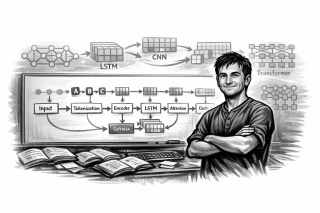
Closing This Chapter
As of now, almost end of 2025, I’m wrapping up this sequence‑modeling project. Not because it failed but because it achieved exactly what it was meant to: deep technical understanding.
This was never intended for production. It was designed as a laboratory for learning the lowest layers of ML architecture. And it delivered.
What I’m Seeing in the Results
The core insight is clear: Network behavior is absolutely learnable when encoded correctly.
Representation was the real architecture. Tokenization quality dictated model performance. When the symbolic compression was clean, models behaved well. When it wasn’t, they collapsed into repetition or noise.
Sequential models consistently outperformed non‑sequential ones. Transformers showed power but required careful tuning. Bayesian models captured surprisingly strong transition signals. MLPs served as useful baselines but lacked temporal awareness.
Each architecture taught me something different about the underlying structure of ML architecture in context of network behavior.
Why I’m Proud of This Work
This project forced me to operate at the lowest levels of ML design and not just using models, but understanding them.
Debugging sequence collapse. Tuning attention heads. Experimenting with reversed sequences. Running Optuna sweeps. Breaking tokenizers and rebuilding them. Watching models learn, fail, and recover. This wasn’t “apply a model and see what happens.” This was pure engineering.
“Understanding the machine is always more valuable than using the machine.”
Why Production Was Never the Target
A production system requires scale, reliability, and operational guarantees. This project wasn’t built for that. It was built to answer a research question: Can network behavior be forecasted?
Now I know the answer: Yes, with the right representation and architecture.
What I’m Taking With Me
The real output is capability. I now understand:
- How to compress traffic into meaningful tokens
- How different architectures interpret temporal structure
- How long‑range dependencies behave in network sequences
- How to debug degenerate predictions
- How to design a full sequence‑modeling pipeline end‑to‑end
This project elevated my technical depth in a way no course or book could. And that’s exactly why I built it 🙂