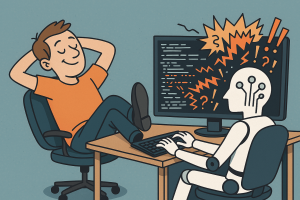
recently I heard someone confidently say: “you don’t need to learn how to code anymore. nobody needs to. AI will do it for you.” this is exactly the kind of thinking that keeps pushing us further away from understanding the root of anything.
if we follow that logic, then we also don’t need to teach math because calculators exist. we don’t need to teach writing because there is autocorrect. we don’t need to teach navigation because GPS will tell us where to go. and apparently, we don’t need to teach cybersecurity because some vendor will sell us a blinking dashboard that “does it all.”
this mindset is not just wrong — it is dangerous.
AI is a tool. a powerful one, yes, but still a tool. and tools amplify the person using them. if you don’t understand the fundamentals, AI won’t save you. it will simply help you make mistakes faster, at scale, and with more confidence.
the funniest part is this: the same people who say “nobody needs to learn coding anymore” are the ones waiting for someone else to build the AI app that will magically code for them. so who exactly is going to build that app? who is going to write the logic, the architecture, the models, the guardrails? AI doesn’t appear out of thin air. it is built by people who understand the underlying systems deeply — not by people who outsource their thinking to a chatbot.
cybersecurity has already suffered from this mentality for decades. we keep buying tools instead of understanding threats. we keep installing agents instead of learning attack vectors. we keep chasing acronyms instead of studying adversaries. and then we are shocked when breaches happen “unexpectedly.”
AI will not fix this. in fact, it will make the gap even wider between those who understand the fundamentals and those who rely on shortcuts.
if you don’t know how something works, you cannot secure it. if you don’t understand logic, you cannot validate AI’s output. if you don’t understand code, you cannot trust code written for you.
AI is not a replacement for knowledge. it is a multiplier of whatever knowledge you already have — or don’t have.
the boundary is simple: use AI to accelerate your thinking, not to replace it. use AI to explore ideas, not to avoid learning. use AI to enhance your skills, not to erase them.
otherwise we will end up with a generation of “experts” who know how to press buttons but have no idea what happens behind them. and that is not expertise — that is dependency.