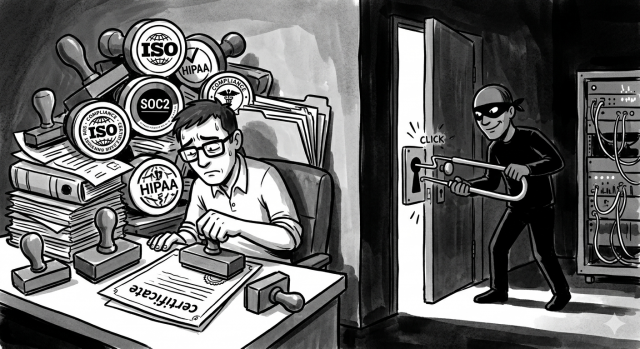
When “Check-the-Box” Fails
Most companies today live in a dream world. They think that passing an audit or getting a certification means their software is secure. It does not. Regulatory compliance is not security, it is just paperwork. If your software is built on a foundation of neglect, it is already waiting to be exploited.
10 Signs Your Software Is an Open Door
If you see these patterns, you are not secure; you are just lucky so far:
- Security is an afterthought. You write the code first, make it work, and then “add” security at the end. That is like adding seatbelts after the car has already crashed.
- No Secure SDLC. If your developers haven’t been trained on a Secure Software Development Life Cycle, they are building with their eyes closed.
- Ignoring first principles. You are importing massive, bloated libraries to solve simple problems because you never learned how to build from the ground up.
- Management is checked out. If the leadership thinks a shiny tool like a SAST scanner is a substitute for a real security culture, they have already failed the team.
- Documentation over design. You have plenty of policy documents that look great to an auditor, but your actual code is a mess of spaghetti logic.
- No threat modeling. You never asked, “How could someone break this?” before you started typing. You only ask that question when you are already in production.
- Over-reliance on automation. You let AI or scanners find your bugs because you don’t actually know how to read your own code well enough to spot them.
- Politics over logic. Every security fix is a negotiation with management rather than a technical necessity.
- You lack a clear baseline. You cannot define what “normal” behavior looks like for your application, so you have no way to detect when it is being attacked.
- The “Copy-Paste” Culture. You are copying boilerplate code from the internet without verifying it, just to hit a deadline.
The Reality of Exploitation
Compliance is a static snapshot; an exploit is a moving target. When you treat security as a burden to be managed rather than a craft to be mastered, you give the attacker every advantage. You can fill out all the forms you want, but a hacker does not care about your compliance badge. They care about your logic errors, your unpatched dependencies, and your lazy design.
“The joy of invention has been replaced by the speed of assembly”.
Stop hiding behind acronyms and marketing buzzwords. If you aren’t training your people to understand the fundamentals of secure coding, you aren’t protecting your customers. You are just handing the attacker the keys to the kingdom.