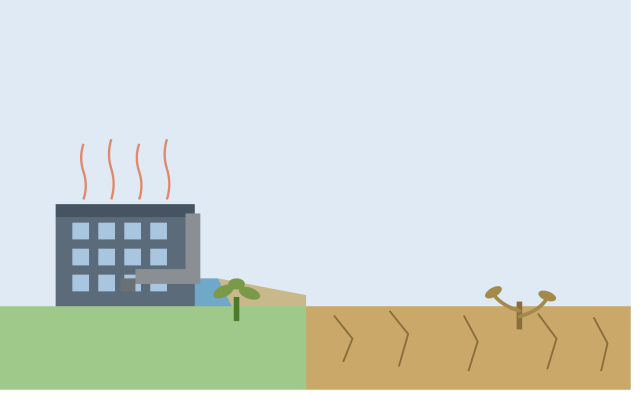
There is a point in every industry where you have to step out of the weeds and look at the whole landscape. AI has reached that point. The mainstream conversation is stuck on the technical treadmill: new models, new infrastructure, new GPUs, new frameworks, new benchmarks. All fascinating, no doubt. But fascination is not the same as awareness. And awareness is not the same as responsibility. The AI industry has grown into something distinct, something with its own gravity, its own appetite, and its own consequences.
The real challenges are not just technical. They are structural, environmental, and human. We talk about learning machines as if they exist in a vacuum, as if the only cost is the electricity bill and the only risk is a hallucinated answer. But the truth is more physical, more primitive, and more uncomfortable. These machines generate heat — enormous, relentless heat. If you remember your old 486 CPU warming up after AutoCAD rendered a simple blueprint, multiply that by a few thousand, then multiply again by the industrial-grade GPUs that power today’s AI farms. The NVIDIA GeForce RTX 5090, a consumer GPU, can warm an entire room under load. That’s one chip. Now imagine the heat output of a full rack of H100s or B200s running 24/7. Imagine a warehouse full of them. Imagine a continent full of warehouses.
Heat demands cooling, and cooling demands water. Not metaphorically, literally. Water is the only feasible solution at scale. This is why AI farms sit next to rivers, lakes, and reservoirs. They are not there for scenery. They are there because the machines would melt without them. And this is where the conversation becomes uncomfortable. Because while the AI industry is pumping water through closed-loop cooling systems, the rest of the world is dealing with scarcity. UNICEF reports that four billion people, almost two-thirds of humanity, experience severe water scarcity for at least one month each year. The problem is not total global supply; the problem is distribution, timing, and infrastructure. Water exists, but not where people need it, not when they need it, and not in the form they need it.
So the question becomes painfully simple: do we need food or the next-generation AI model? Approximately 673 million people experienced hunger worldwide in 2024. Hunger is not theoretical. Hunger is not a future risk. Hunger is not a philosophical debate. Hunger is pain. Hunger is a child who cannot sleep. Hunger is a farmer who cannot irrigate. Hunger is a region that cannot sustain itself. And while hunger is real, AI’s promises are still promises. “These machines will help cure cancer.” Maybe. Hopefully. But not today. Today, the machines are consuming water that agriculture needs. Today, the machines are generating heat that must be cooled. Today, the machines are expanding faster than the infrastructure that supports human life.
This is not a call to abandon technology and return to tractors and hand tools. It is a call to direct technology toward what actually matters. Clean water matters. Food security matters. Infrastructure matters. Human survival matters. AI development is not inherently harmful, but the scale of its resource consumption is becoming impossible to ignore. The devil is in the details, not in the abstract concept of “AI,” but in the way the computation power is being used. Education, entertainment, discovery, medicine, AI development itself…all valid fields, all meaningful. But not all equally urgent. And not all equally deserving of the water being diverted to cool the machines.
Someone will pay the price for this water. It will not be the AI companies. It will not be the engineers. It will not be the investors. It will be the regions already struggling with scarcity. It will be the populations already dealing with hunger. It will be the industries that depend on water for survival, not for computation. The AI industry is not Terminator. It is not I, Robot. It is not a cinematic threat. It is a physical one, a resource competitor. And if we do not rethink the application of this unleashed industry, the cost will not be measured in benchmarks or model sizes. It will be measured in human lives!