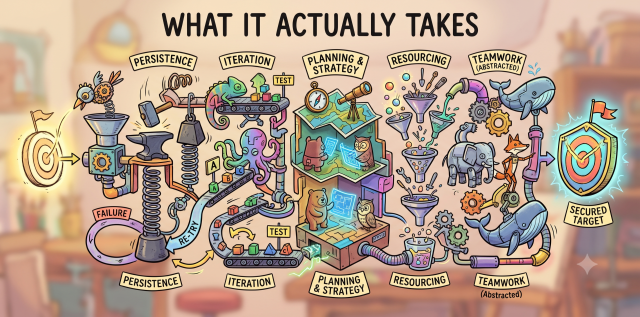
Nobody wants to hear this. But someone has to say it: The industry is full of people who collected certificates like trading cards, dropped a university name in their bio, and convinced a hiring manager they could secure a network they have never actually touched. It works, for a while. Then reality shows up. You cannot fake depth. Not forever. People feel it.
It starts with how you think, not what you know
Systems thinking is not a buzzword. It is the ability to look at a network, a pipeline, an organization, and see the relationships, not just the components. Most people see a firewall. A systems thinker sees the firewall, the team managing it, the process behind the rule changes, and the three assumptions baked into the policy that nobody has questioned in four years. That is where the real risk lives. Not in the CVE. In the assumption.
Engineering intuition is earned, not taught
You do not get engineering intuition from a course. You get it from breaking things, fixing things, staying up late with a config that should work and does not, and eventually developing a sense, almost physical, for when something is wrong before you can prove it.
“A good mechanic does not just read the diagnostic. He listens to the engine.”
That intuition is what separates the person who finds the vulnerability from the person who writes a report about the person who found it.
Curiosity is the engine. Discipline is the fuel.
Curiosity without discipline is just noise. You chase every shiny tool, every new framework, every trending attack technique and you go deep on nothing. Discipline is what turns curiosity into capability. It is what makes you sit with ML experimentation long enough to actually understand what the model is doing, not just run the notebook someone else wrote.
These two are not optional. They are the engine and the fuel. Without both, you are not moving.
Security depth is not a specialization. It is a commitment.
You can be broad. Broad is fine early. But at some point you have to go deep somewhere, deep enough that you can smell when something is wrong in your domain without needing a checklist. Deep enough that junior people come to you not because of your title but because you actually know.
That depth takes time. It takes autonomy, the ability to direct your own learning, run your own experiments, make your own calls without waiting for permission.
The part nobody talks about: a runway and a plan
You need time to build something real. That means you need a runway, financial, professional, personal. You cannot grow if you are in permanent survival mode, chasing the next paycheck, the next certification to satisfy a job description written by someone who does not know what the job actually requires.
And you need a plan that is forming. Not finished. Forming. The people who wait until the plan is perfect never start. The people who are building, adjusting, and moving, they get somewhere.
“You do not need a map. You need a compass and the discipline to keep walking.”
The desire to build something real
This is the hardest one to fake and the easiest one to spot when it is missing.
Are you here to accumulate credentials or to actually build something? A tool, a practice, a body of work, a team that is genuinely better because you were in it. That desire, when it is real, changes how you work, how you learn, and what you are willing to tolerate in yourself when you fall short.
The certificate does not give you that. Stanford does not give you that. Nobody gives you that. You either have it or you go find it.